


NOW AVAILABLE
VETMEDIN® Solution (pimobendan oral solution)
Treatment for Congestive Heart
Failure
For dogs who have already progressed to congestive heart failure due to myxomatous mitral valve disease
(MMVD) or dilated cardiomyopathy (DCM) and who prefer liquid medication.
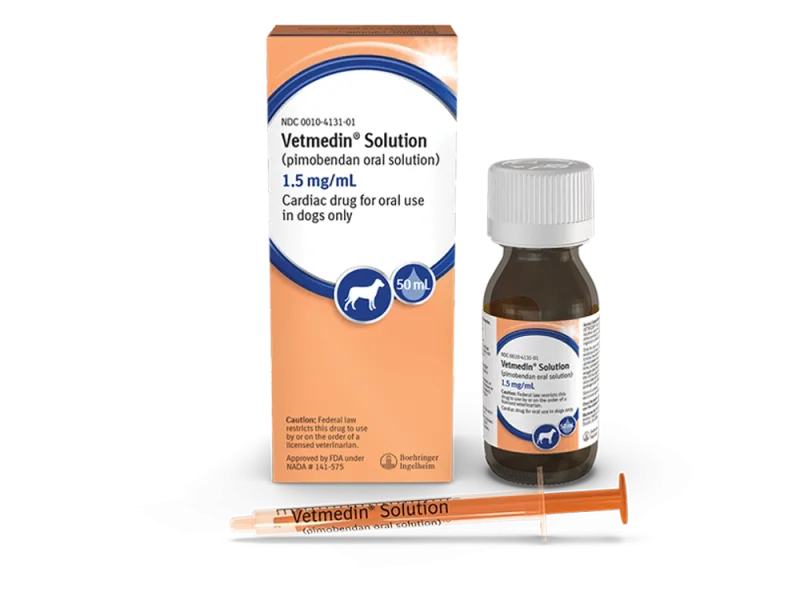
VETMEDIN® Solution
(pimobendan oral solution)
An oral solution that's flavorless for dogs who prefer a liquid medication.
An oral solution that's flavorless for dogs that prefer a liquid medication.
For dogs that have already progressed to congestive heart failure due to Myxomatous Mitral Valve Disease (MMVD) or Dilated cardiomyopathy (DCM).
About VETMEDIN® Solution
(pimobendan oral solution)
VETMEDIN® Solution makes administration easy for dogs who prefer liquid medication.
In a study on dogs with congestive heart failure, more than half of dogs treated with VETMEDIN® products showed significant improvements in breathing and energy levels in as little as 7 days.1
Dosage and Administration
VETMEDIN® Solution should be given to your dog twice a day - morning and at night - approximately 12 hours apart. See your veterinarian as well as full prescribing information for more details.
FAQs
What are the most common heart diseases in dogs?
- Myxomatous Mitral Valve Disease (MMVD): A progressive condition where the mitral valve, a valve that helps control one-way blood flow between chambers of the heart, becomes thickened and misshapen, leading to leakage and heart enlargement. It's most common in small breeds, especially older Cavalier King Charles Spaniels.
- Dilated Cardiomyopathy (DCM): A disease of the heart muscle where muscle walls thin and the chambers become enlarged. It primarily affects large breeds like Dobermans, Boxers, and Great Danes.
- Congenital Heart Defects: These are present at birth and can include conditions like patent ductus arteriosus (PDA), pulmonic stenosis, and aortic stenosis. PDA occurs when blood is redirected back to the lungs and can cause fluid build-up and may eventually lead to heart failure. Aortic and Pulmonic stenosis are the narrowing of critical heart valves and may cause the heart muscle to thicken and eventually lead to heart failure.
How do VETMEDIN® Brand Products work?
VETMEDIN Brand Products have a unique, dual mode of action to help your dog’s heart. They relax the blood vessels carrying blood to and from the heart, reducing the load on your dog’s heart. At the same time, they work to improve the muscle function of the heart to help it work more efficiently.2
How long will my dog require treatment with VETMEDIN® Brand Products?
In the asymptomatic setting, you would continue to use VETMEDIN® CA-1 until such time as your dog goes into congestive heart failure (CHF), then you would transition your dog to VETMEDIN® Chewable Tablets or VETMEDIN® Solution and your dog would remain on that medication until the end of your dog's life to help control signs of heart failure. Not all dogs with asymptomatic disease will progress to heart failure.
Do VETMEDIN® Brand Products have any side effects?
For VETMEDIN-CA1 Chewable Tablets, the most common side effects seen, not related to disease progression, were diarrhea, vomiting, pain, lameness, arthritis, urinary tract infection, and seizure. For VETMEDIN Chewable Tablets and VETMEDIN Solution, the most common side effects seen were poor appetite, tiredness, shortness of breath, weakness, lack of muscle control and coordination, and diarrhea. If your dog experiences any of these side effects, contact your vet.
What should I do if I forget to give a dose of a VETMEDIN® Brand Product?
Wait until the next scheduled dosing time and resume the normal twice-daily (every 12 hours) pattern of dosing.
What should I do if my dog vomits shortly after dosing?
Speak to your vet. Some dogs in our clinical trials experienced transient mild vomiting that resolved after a few doses. If vomiting is severe or persistent, discontinue the medication and speak to your vet.
What’s the difference between the VETMEDIN® (pimobendan) brand and a compounded pimobendan?
The primary difference between VETMEDIN® (pimobendan) brand and a compounded pimobendan is FDA evaluation. VETMEDIN® is approved by the FDA, which means it has been tested for safety and manufacturing quality is certified. The FDA does not evaluate compounded products for evidence that they are safe, effective, properly manufactured, accurately labeled, and adequately packaged. Compounders are not required to report adverse events or demonstrate stability or other product quality measures. A veterinarian or pharmacist must follow FDA guidelines when compounding, but each compounded formulation is unique as it is individually manufactured from sourced ingredients or adapted from existing drugs to the unique needs of the pet.3

Education
If your dog has been diagnosed with a heart disease such as congestive heart failure (CHF), myxomatous mitral valve disease (MMVD) or dilated cardiomyopathy (DCM), our education articles will provide you with information about the conditions, common symptoms, treatment options, and resources to help you and your dog navigate this journey.

Heart Disease in Dogs
Heart disease is common—10% of dogs will be diagnosed with heart disease in their lifetime.1,2 Early intervention can help extend survival time, with a higher quality of life.

Types of Heart Diseases
Educate yourself on the ins and outs of heart diseases like myxomatous mitral valve disease (MMVD) and dilated cardiomyopathy (DCM) and how they can lead to congestive heart failure in dogs.

Your Guide to Congestive Heart Failure
Hearing that your dog has heart disease or congestive heart failure (CHF) can be a worrying time. Although congestive heart failure is a serious condition, with early diagnosis and treatment, dogs can live a happy life for many months, and even years.

Signs of Congestive Heart Failure
When a dog’s heart disease progresses to congestive heart failure, you may notice these clinical signs. If you see these signs in your dog, contact your vet immediately. With proper treatment, many dogs diagnosed with congestive heart failure go on to enjoy an improved quality of life.

Breeds at Risk for Heart Failure due to MMVD and DCM
Different kinds of heart failure impact different breeds, so learn more about the risks for your dog.

VETMEDIN® (pimobendan) or Compounded medications
If your dog has a certain type of heart disease, your veterinarian may recommend a medication called VETMEDIN® (pimobendan). You might also hear about something called compounded medications. Let's break it down so you can make the best choice for your dog.
Important Safety Information
VETMEDIN® (pimobendan) Chewable Tablets and VETMEDIN® Solution (pimobendan oral solution) are for use only in dogs with clinical evidence of heart failure. The most common side effects reported in field studies were poor appetite, lethargy, diarrhea, dyspnea, azotemia, weakness, and ataxia. VETMEDIN® should not be given in case of hypertrophic cardiomyopathy, aortic stenosis, or any other clinical condition where an augmentation of cardiac output is inappropriate for functional or anatomical reasons.
For more information, please see full prescribing information for Solution or full prescribing information for Chewable Tablets.
VETMEDIN®-CA1 (pimobendan) are for use only in dogs with preclinical MMVD that have a moderate or loud mitral murmur due to mitral regurgitation and cardiomegaly (Stage B2 MMVD, 2019 ACVIM Consensus Statement1). VETMEDIN®-CA1 is conditionally approved by FDA pending a full demonstration of effectiveness under application number 141-556. A diagnosis of MMVD should be made by means of a comprehensive physical and cardiac examination, which should include radiography and echocardiography. The most common side effects seen in dogs with Stage B2 MMVD while taking VETMEDIN®-CA1 Chewable Tablets are cough, vomiting, diarrhea, lethargy and localized pain (such as in the neck or legs). Adverse reactions not related to disease progression in dogs receiving VETMEDIN®-CA1 included diarrhea, vomiting, pain, lameness, arthritis, urinary tract infection, and seizure.
For more information, please refer to the package insert.