


Give Your Dog
More Life to Love
Timely vet check-ups and treatment can transform heart disease from a life-threatening situation to a manageable ailment. Empower your dog's heart health with expert education, early screening insights, and breed-specific risk awareness for proactive care.

If your dog has been diagnosed with a heart disease such as congestive heart failure (CHF), myxomatous mitral valve disease (MMVD), or dilated cardiomyopathy (DCM), you’ve come to the right place for information about treatment options, the conditions, common signs, and resources to help you and your dog navigate this journey.
Treatment Options
The treatment options for the heart diseases MMVD and DCM depend on your dog’s current stage of disease. See below for more information on which product is appropriate to use during each stage.

Early-Stage
Treatment for
MMVD
Dogs in an early stage of the most common form of heart disease, myxomatous mitral valve disease (MMVD), have a treatment option. Catching this condition early and treating it before it progresses is important to maximize the therapeutic benefit for your dog.
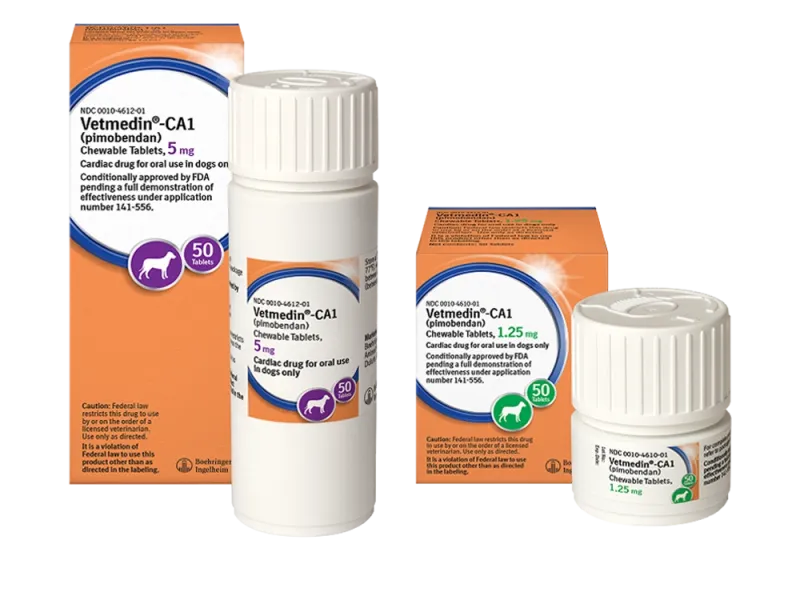
VETMEDIN®-CA1 (pimobendan)
Chewable Tablets
VETMEDIN®-CA1 Chewable Tablets treat an early stage of the heart disease MMVD to give dogs up to an average of 15.6 more months of symptom-free life.¹
It's the only medication (conditionally) approved by the FDA to delay the onset of heart failure.
For dogs in an early stage of myxomatous mitral valve disease (MMVD).
It's the medication (conditionally) approved by the FDA to delay the onset of heart failure.
Later-Stage
Treatment for
MMVD or DCM
For dogs who have already progressed to congestive heart failure due to MMVD or dilated cardiomyopathy (DCM), there are 2 forms of the same treatment.
Both contain the same medication vets have trusted for years, just in different forms. VETMEDIN® (pimobendan) is the only brand approved by the FDA that includes both tablet and liquid formulations to treat dogs with certain types of congestive heart failure (CHF).
In a study on dogs with congestive heart failure, 55% of dogs treated with VETMEDIN® products showed significant clinical improvement in as little as 7 days.2
Your veterinarian may prescribe additional medication for your dog when they are in congestive heart failure.
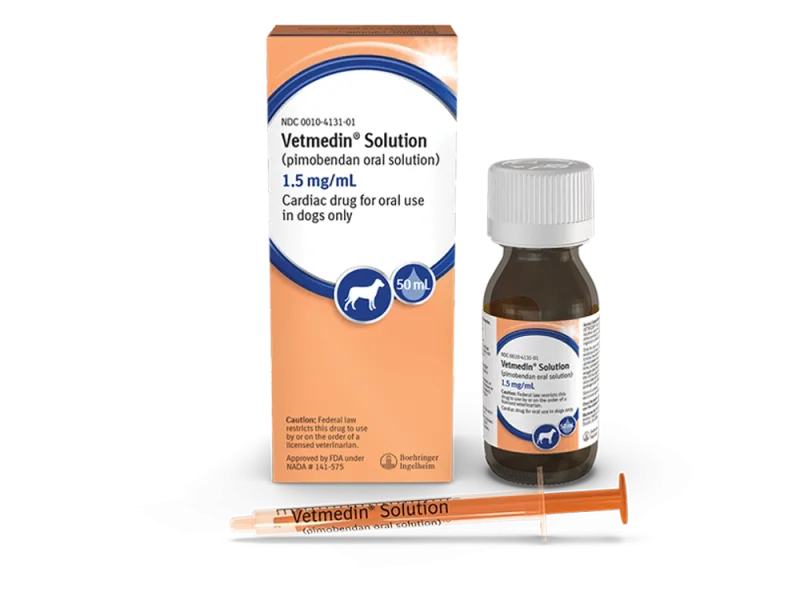
VETMEDIN® Solution
(pimobendan oral solution)
An oral solution that's flavorless for dogs who prefer a liquid medication.
An oral solution that's flavorless for dogs that prefer a liquid medication.
For dogs that have already progressed to congestive heart failure due to Myxomatous Mitral Valve Disease (MMVD) or Dilated cardiomyopathy (DCM).
VETMEDIN® (pimobendan)
Chewable Tablets
Beef-flavored and half-scored to meet the dosing needs for dogs who prefer chews.
Beef-flavored and half-scored to meet the dosing needs for dogs who prefer chews.
For dogs that have already progressed to congestive heart failure due to Myxomatous Mitral Valve Disease (MMVD) or Dilated cardiomyopathy (DCM).

Screening and management is crucial
Understanding Heart
Disease in Dogs
Heart disease in dogs affects heart function and circulation. It can be something a dog is born with or something they develop over time due to wear, injury, or infection. Even young dogs are at risk. Regular vet check-ups are crucial for early detection and management.

What are the most common heart diseases in dogs?
- Myxomatous Mitral Valve Disease (MMVD): A progressive condition where the mitral valve, a valve that helps control one-way blood flow between chambers of the heart, becomes thickened and misshapen, leading to leakage and heart enlargement. It's most common in small breeds, especially older Cavalier King Charles Spaniels.
- Dilated Cardiomyopathy (DCM): A disease of the heart muscle where muscle walls thin and the chambers become enlarged. It primarily affects large breeds like Dobermans, Boxers, and Great Danes.
- Congenital Heart Defects: These are present at birth and can include conditions like patent ductus arteriosus (PDA), pulmonic stenosis, and aortic stenosis. PDA occurs when blood is redirected back to the lungs and can cause fluid build-up and may eventually lead to heart failure. Aortic and Pulmonic stenosis are the narrowing of critical heart valves and may cause the heart muscle to thicken and eventually lead to heart failure.
What breeds are at risk of Heart Failure due to MMVD?
MMVD is the most common type of heart disease in dogs, particularly in small to medium-sized breeds. Dogs with this type of heart disease develop distorted heart valves, which no longer close properly. Veterinarians can hear the backward blood flow, referred to as a heart murmur, with a stethoscope.
Predisposed dog breeds:
- Cavalier King Charles Spaniel
- Chihuahua
- Dachshund
- Maltese
- Miniature Poodle
- Miniature Schnauzer
- Shih Tzu
This is not a complete list of at-risk breeds.
What breeds are at risk of Heart Failure due to DCM?
DCM is a condition most commonly seen in larger-breed dogs. The heart and the heart muscle of dogs with DCM is stretched and thinned along with the heart structure, resulting in the heart being unable to effectively pump blood.
Predisposed dog breeds:
- Cocker Spaniel
- Doberman Pinscher
- Golden Retriever
- Great Dane
- Irish Wolfhound
- Labrador Retriever
This is not a complete list of at-risk breeds
What are common signs to look out for?
In the early stages of the disease your dog will show no symptoms and not all dogs will go into heart failure. Depending on how severe a dog’s congestive heart failure is, symptoms may occur when a dog is resting, during mild exercise, or during moderate or extreme exertion. If any of these signs are noted in your dog, contact your vet as soon as possible.
Clinical signs can include:
- Coughing, especially during or after exercise or while resting
- Difficulty breathing or rapid, shallow breathing
- Tiring easily during physical activity or exercise intolerance
- Lethargy or weakness
- Decreased appetite or weight loss
- Abdominal distension or bloating
- Restlessness, pacing, or discomfort
- Fainting or collapse in severe cases
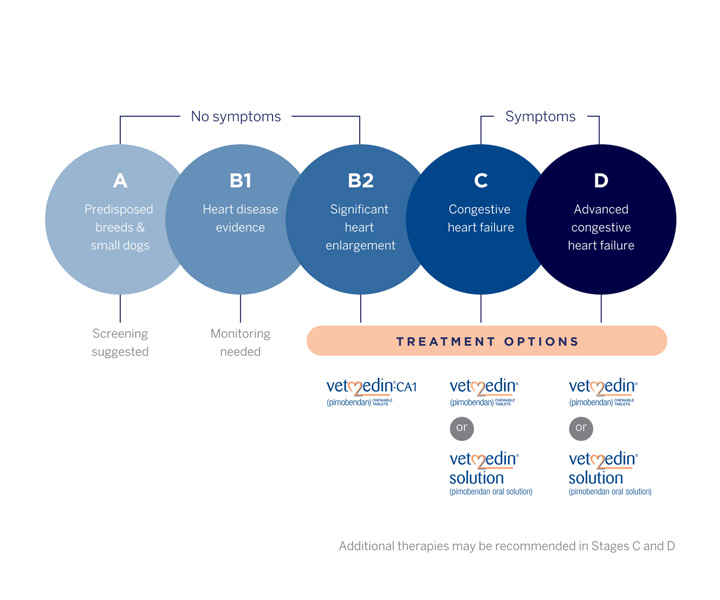
MMVD Progress in Dogs
This chart shows how dogs may progress through the stages of MMVD into congestive heart failure, including when clinical symptoms become visible. It also includes the recommended steps or treatments for each stage of the disease.

Education
If your dog has been diagnosed with a heart disease such as congestive heart failure (CHF), myxomatous mitral valve disease (MMVD) or dilated cardiomyopathy (DCM), our education articles will provide you with information about the conditions, common symptoms, treatment options, and resources to help you and your dog navigate this journey.

Heart Disease in Dogs
Heart disease is common—10% of dogs will be diagnosed with heart disease in their lifetime.1,2 Early intervention can help extend survival time, with a higher quality of life.

Types of Heart Diseases
Educate yourself on the ins and outs of heart diseases like myxomatous mitral valve disease (MMVD) and dilated cardiomyopathy (DCM) and how they can lead to congestive heart failure in dogs.

Your Guide to Congestive Heart Failure
Hearing that your dog has heart disease or congestive heart failure (CHF) can be a worrying time. Although congestive heart failure is a serious condition, with early diagnosis and treatment, dogs can live a happy life for many months, and even years.

Signs of Congestive Heart Failure
When a dog’s heart disease progresses to congestive heart failure, you may notice these clinical signs. If you see these signs in your dog, contact your vet immediately. With proper treatment, many dogs diagnosed with congestive heart failure go on to enjoy an improved quality of life.

Breeds at Risk for Heart Failure due to MMVD and DCM
Different kinds of heart failure impact different breeds, so learn more about the risks for your dog.

VETMEDIN® (pimobendan) or Compounded medications
If your dog has a certain type of heart disease, your veterinarian may recommend a medication called VETMEDIN® (pimobendan). You might also hear about something called compounded medications. Let's break it down so you can make the best choice for your dog.
Monitor Heart Health
With My Pet’s
Heart2Heart App
Monitoring your dog's resting respiratory rate (RRR) can reliably predict if your dog will go into heart failure and identify heart disease progression. Download the My Pet's Heart2Heart app to make it easy to monitor your dog's RRR at home. The app will regularly email results to your vet to ensure your dog receives care as soon as it's needed. Follow up for a consultation with your vet if you have any concerns.

Important Safety Information
VETMEDIN® (pimobendan) Chewable Tablets and VETMEDIN® Solution (pimobendan oral solution) are for use only in dogs with clinical evidence of heart failure. The most common side effects reported in field studies were poor appetite, lethargy, diarrhea, dyspnea, azotemia, weakness, and ataxia. VETMEDIN® should not be given in case of hypertrophic cardiomyopathy, aortic stenosis, or any other clinical condition where an augmentation of cardiac output is inappropriate for functional or anatomical reasons.
For more information, please see full prescribing information for Solution or full prescribing information for Chewable Tablets.
VETMEDIN®-CA1 (pimobendan) are for use only in dogs with preclinical MMVD that have a moderate or loud mitral murmur due to mitral regurgitation and cardiomegaly (Stage B2 MMVD, 2019 ACVIM Consensus Statement1). VETMEDIN®-CA1 is conditionally approved by FDA pending a full demonstration of effectiveness under application number 141-556. A diagnosis of MMVD should be made by means of a comprehensive physical and cardiac examination, which should include radiography and echocardiography. The most common side effects seen in dogs with Stage B2 MMVD while taking VETMEDIN®-CA1 Chewable Tablets are cough, vomiting, diarrhea, lethargy and localized pain (such as in the neck or legs). Adverse reactions not related to disease progression in dogs receiving VETMEDIN®-CA1 included diarrhea, vomiting, pain, lameness, arthritis, urinary tract infection, and seizure.
For more information, please refer to the package insert.