
Types of Heart Diseases

Educate yourself on the ins and outs of heart diseases like myxomatous mitral valve disease (MMVD) and dilated cardiomyopathy (DCM) and how they can lead to congestive heart failure in dogs.


Certain Types of Heart Disease Can Lead to Heart Failure
Acquired heart disease is most often manifested in 2 ways: valve disease and cardiomyopathy. Both forms of heart disease can lead to heart failure.
Myxomatous Mitral Valve Disease (MMVD)
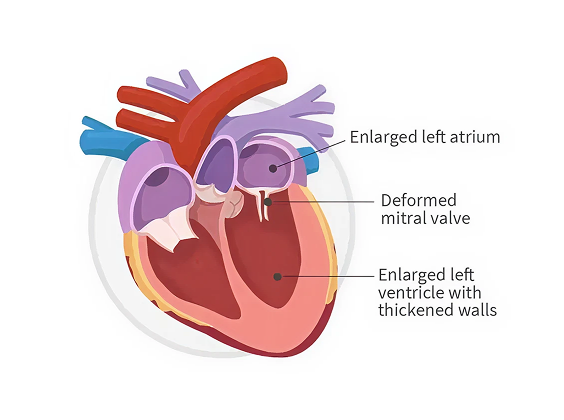
In dogs with this type of heart disease, the valves become distorted and no longer close properly. Your vet can hear backward blood flow, called a heart murmur, with a stethoscope.
MMVD is most commonly seen in small and medium-sized breeds and progresses slowly. It is also known as mitral valve insufficiency or mitral regurgitation and is often associated with a heart murmur.
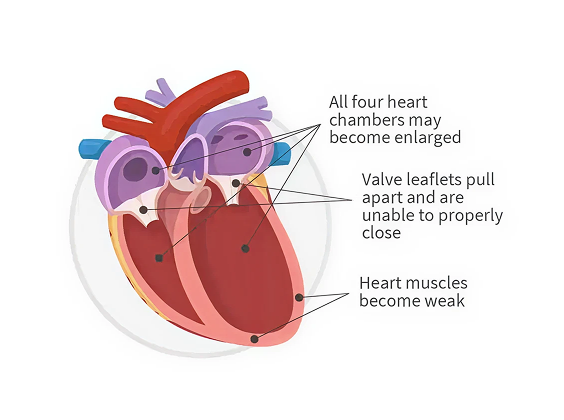
Dilated cardiomyopathy (DCM) in dogs
This disease of the heart muscle causes the walls of the heart to stretch and thin, weakening as the heart enlarges. Because the heart is weakened, it can no longer pump blood effectively. Myocardial disease most often affects large breeds and progresses rapidly.
Both of these forms of heart disease can lead to heart failure.
What is Congestive Heart Failure?
Once in failure, the dog can no longer compensate for the progressively ineffective heart, leading to a poorer quality of life and, without intervention, a poor prognosis.
Dogs diagnosed with congestive heart failure should begin treatment upon diagnosis. While treatment will not cure the underlying causes of heart failure, it can increase survival time as well as improve the quality of your pet’s life.1,2
Kathleen Buffington
Kathleen “Kat” Buffington graduated from the University of Georgia’s School of Agriculture with a degree in biology. She began an over decade-long career in the animal health industry where she’s pursued her passion: training and educating others in all aspects of animal health. Outside of her career, she enjoys spending time with her friends and family, including 2 cats and 2 dogs.

Important Safety Information
VETMEDIN® (pimobendan) Chewable Tablets and VETMEDIN® Solution (pimobendan oral solution) are for use only in dogs with clinical evidence of heart failure. The most common side effects reported in field studies were poor appetite, lethargy, diarrhea, dyspnea, azotemia, weakness, and ataxia. VETMEDIN® should not be given in case of hypertrophic cardiomyopathy, aortic stenosis, or any other clinical condition where an augmentation of cardiac output is inappropriate for functional or anatomical reasons.
For more information, please see full prescribing information for Solution or full prescribing information for Chewable Tablets.
VETMEDIN®-CA1 (pimobendan) are for use only in dogs with preclinical MMVD that have a moderate or loud mitral murmur due to mitral regurgitation and cardiomegaly (Stage B2 MMVD, 2019 ACVIM Consensus Statement1). VETMEDIN®-CA1 is conditionally approved by FDA pending a full demonstration of effectiveness under application number 141-556. A diagnosis of MMVD should be made by means of a comprehensive physical and cardiac examination, which should include radiography and echocardiography. The most common side effects seen in dogs with Stage B2 MMVD while taking VETMEDIN®-CA1 Chewable Tablets are cough, vomiting, diarrhea, lethargy and localized pain (such as in the neck or legs). Adverse reactions not related to disease progression in dogs receiving VETMEDIN®-CA1 included diarrhea, vomiting, pain, lameness, arthritis, urinary tract infection, and seizure.
For more information, please refer to the package insert.