


Your attention
matters more
than ever.
Monitoring daily activity can tell you and your vet a lot about your dog's heart. Measuring their resting respiratory rate (RRR) is the key—and it's easy.
What RRR tells you
Your dog's resting respiratory rate is an indication of how hard their heart is working. The higher the rate, the harder it's likely working.

How to measure resting respiratory rate
It's important to know if the number is generally consistent. Any sudden, drastic increase in RRR is a sign to call your vet. Start by establishing a baseline with a daily average. Contact your vet if RRR is 20% higher than the first week's average.
Practice Timer
Count your dog's breaths for 15 seconds and multiply by 4 (inhale + exhale = one breath)

Wait until asleep and calm
Ensure your dog is resting peacefully

Start 15s timer and count
Count each full chest rise and fall

Multiply by 4 and log
Record in the Heart2Heart app

Record RRR daily for one week
To calculate an average (add up and divide by 7)

Record RRR once a week going forward

Record RRR daily for one week to calculate an average
(add up and divide by 7)

Record RRR once a week going forward
Contact your vet if RRR is 20% higher or more than the average recorded in Week 1
More symptoms to watch for
There are other symptoms of heart disease you can monitor for on a monthly basis. The appearance of these signs can indicate progression to heart failure and requires prompt vet attention and plan updates. Consider recording your observations on your smartphone, digital calendar, AI assistant, or a simple wall calendar to help you keep track.
What should you monitor?
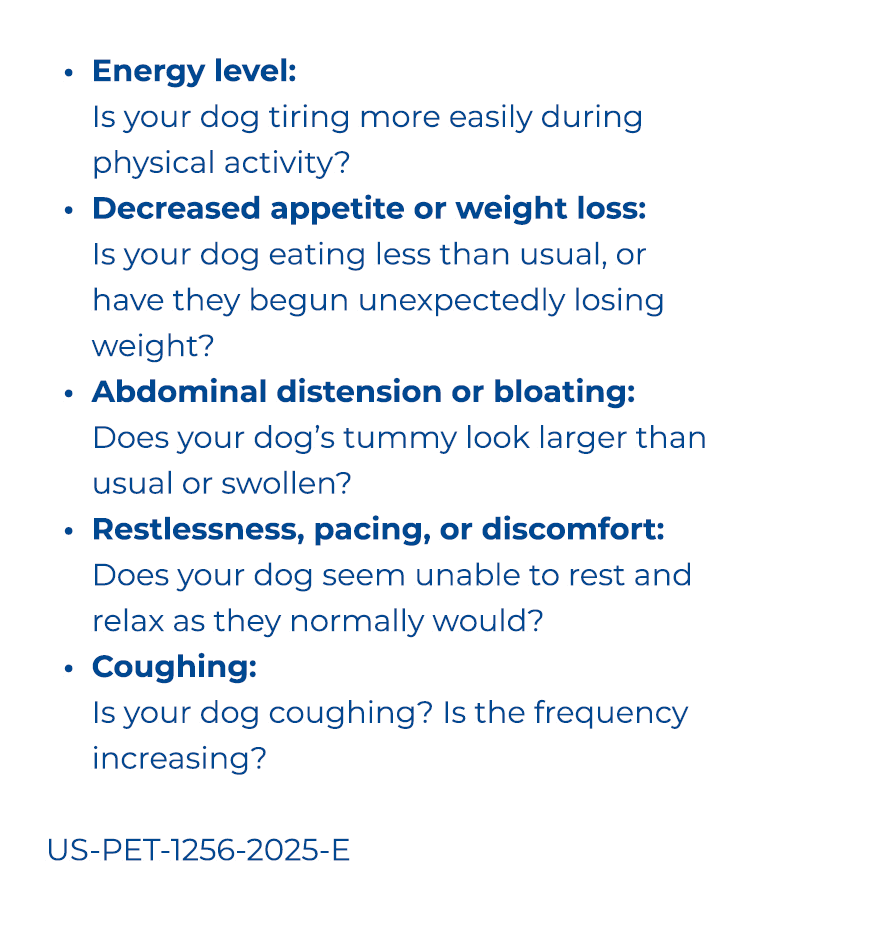
- Energy level: Is your dog tiring more easily during physical activity?
- Decreased appetite or weight loss: Is your dog eating less than usual, or have they begun unexpectedly losing weight?
- Abdominal distension or bloating: Does your dog's tummy look larger than usual or swollen?
- Restlessness, pacing, or discomfort: Does your dog seem unable to rest and relax as they normally would?
- Coughing: Is your dog coughing? Is the frequency increasing?

Know the warning signs
If you need help recognizing symptoms, here's what they may look or sound like: (belly breathing, fluid buildup, cough sound examples)
Belly breathing
Pronounced abdominal effort at rest
High respiratory rate (RR) at rest
Rapid breathing when calm

Possible fluid buildup
Abdomen/neck swelling (ascites/edema)

Example cough sound
If you observe these or any of the following, call your vet or emergency clinic immediately:
- Collapse or severe weakness
- Bluish or very pale gums
- Severe, sudden distress
Use My Pet's
Heart2Heart App
to track RRR.
Monitoring your dogs resting respiratory rate can reliably predict if your dog will go into heart failure and identify valve disease progression. Download the My Pet's Heart2Heart app to make it easy to monitor your dog's RRR at home. The app will regularly email results to your vet to ensure your dog receives care as soon as it's needed. Follow up for a consultation with your vet if you have any concerns.

Important Safety Information
VETMEDIN® (pimobendan) Chewable Tablets and VETMEDIN® Solution (pimobendan oral solution) are for use only in dogs with clinical evidence of heart failure. The most common side effects reported in field studies were poor appetite, lethargy, diarrhea, dyspnea, azotemia, weakness, and ataxia. VETMEDIN® should not be given in case of hypertrophic cardiomyopathy, aortic stenosis, or any other clinical condition where an augmentation of cardiac output is inappropriate for functional or anatomical reasons.
For more information, please see full prescribing information for Solution or full prescribing information for Chewable Tablets.
VETMEDIN®-CA1 (pimobendan) are for use only in dogs with preclinical MMVD that have a moderate or loud mitral murmur due to mitral regurgitation and cardiomegaly (Stage B2 MMVD, 2019 ACVIM Consensus Statement1). VETMEDIN®-CA1 is conditionally approved by FDA pending a full demonstration of effectiveness under application number 141-556. A diagnosis of MMVD should be made by means of a comprehensive physical and cardiac examination, which should include radiography and echocardiography. The most common side effects seen in dogs with Stage B2 MMVD while taking VETMEDIN®-CA1 Chewable Tablets are cough, vomiting, diarrhea, lethargy and localized pain (such as in the neck or legs). Adverse reactions not related to disease progression in dogs receiving VETMEDIN®-CA1 included diarrhea, vomiting, pain, lameness, arthritis, urinary tract infection, and seizure.
For more information, please refer to the package insert.